Woman who lost teaching degree over MySpace photo sues university
The Associated Press
MILLERSVILLE, Pa. — A woman denied a teaching degree on the eve of graduation because of a MySpace photo has sued the university.
Millersville University instead granted Stacy Snyder a degree in English last year after learning of her Web-published picture, which bore the caption "Drunken Pirate."
"I dreamed about being a teacher for a long time," said Snyder, 27, who now works as a nanny.
The photo, taken at a 2005 Halloween party, shows Snyder wearing a pirate hat while drinking from a plastic "Mr. Goodbar" cup. It was posted on her own MySpace site.
Although Snyder apologized, she learned the day before graduation that she would not be awarded an education degree or teaching certificate.
Jane S. Bray, dean of the School of Education, accused Snyder of promoting underage drinking, the suit states.
The federal lawsuit seeks at least $75,000 in damages. Millersville spokeswoman Janet Kacskos referred questions to a state System of Higher Education spokesman, who declined comment.
Sunday, April 29, 2007

Monday, April 23, 2007
It was a beautiful moment

Thanks for tonight, everyone.
It was a beautiful moment of honoring the fallen from the Virginia Tech tragedy. I appreciate all those who came tonight and sang . . . I thought it was a perfect occasion for our choir to provide a musical context for the service.
It seems to me that we have become a new choir in the past week or so . . . one that cares more and loves to sing even more . . . am I imagining that?
Monday, April 16, 2007
Ave maris stella (Trond Kverno)
| Ave maris stella | Trond Kverno (b. 1945) |
| Ave, Maris stella, Sumens illud Ave Solve vincla reis, Monstra te esse matrem, Virgo singularis Vitam presta puram Sit laus Deo Patri, Ave gratia plena, dominus tecum Benedicta tu in mulieribus! | Hail thou star of ocean Virgin of all virgins
Through the highest heaven, Hail Mary, full of grace, the Lord is with thee |
The Farmers Boy
| The Farmers Boy | Arr. R. Vaughan Williams (1872-1958) | ||
| Andrew Granlund, conductor | | ||
| The sun went down behind the hill, Across yon dreary moor: When weary and lame a boy there came Unto a farmers door. “Can you tell me if any there be who will give me employ To plough and sow, to reap and mow and be a farmers boy. The daughter said “Pray try the lad, no longer let him seek.” “O yes, dear child” the farmer cried, for tears stold down her cheek. “For those who’ld work ‘tis hard to wait, or wander for employ, To plough and sow, to reap and mow and be a farmers boy. In course of time he grew a man, the good old farmer died; He left the lad the farm he had, his daughter for his bride; And now the lad a farmer is, he smiles and thinks with joy of the lucky day he came that way to be a farmers boy. | |||
Jaglied
| Jaglied | Felix Mendelssohn (1809-1847) |
| Durch schwankende Wipfel Schießt goldener Strahl, Tief unter den Gipfeln Das nebliche Tal. Fern hallt es am Schlosse, Das Waldhorn ruft, Es wiehern die Rosse In die Luft, in die Luft! Bald Länder und Seen Durch Wolkenzug Tief schimmernd zu sehen In schwindelndem Flug, Bald Dunkel wieder Hüllt Reiter und Roß, O Lieb', o Liebe So laß mich los! - Immer weiter und weiter Die Klänge ziehn, Durch Wälder und Heiden Wohin, ach wohin? Erquickliche Frische, Süß-schaurige Lust! Hoch flattern die Büsche, Frei schlägt die Brust. Immer weiter und weiter Die Klänge ziehn, Durch Wälder und Heiden Wohin, ach wohin? | Through swaying treetops a golden ray flashes, far below the summits is the misty valley It rings out in the distance from the castle, the horn calls, the horses whinny into the air. Now lands and lakes, now drifting clouds are to be seen, gleaming afar, in vertiginous flight. Now darkness once again shrouds riders and horses. O love, o love, let me go. Ever further and further the sounds move on, through woods and heaths, whither, ah whither? Invigorating freshness, sweet shivers of delight! The plumes flutter aloft, the heart beats freely. And further and further the sounds move on, the plumes flutter aloft, the heart beats freely. |
Thursday, April 05, 2007
Tuesday, April 03, 2007
Cheap date, life experience

They are offering ballroom dancing lessons at my church for very little money.
The details:
Hello....a reminder that we are beginning new dance lessons tomorrow,
Tuesdays, April 3rd, 7-approximately 8:30pm
Beginner waltz
Using the wonderful dance floor and facilities at South Highland Presbyterian Church on corner of Highland Ave South nd 21st Street (use the very back entrance off 13th Ave south..park there)
$3.00 donation at the door No partner required
If you can't make it one week or so, there will be review each time so just come join us when you can....a few weeks of waltz, then swing, then lots of variety to follow..come and bring a friend!
Call for details 933-0790.
Saturday, March 31, 2007

Flower of Beauty, John Clements
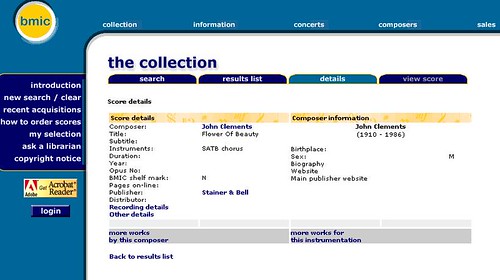
It was really hard to find, but here are the dates for John Clements, who composed "Flower of Beauty" and "There is Sweet Music."
Born: 1910
Died: 1986
(b. 1910 - d. 1986)
(1910-1986)
Thanks to John Helgen, who provided me with the source. You can check it on the British Music Information Centre website. The database MUSICA appears to be wrong, listing the dates for John Clements, actor, who was born in the same year.
Friday, March 30, 2007
i thank you god
i thank You God for most this amazing
day:for the leaping greenly spirits of trees
and a blue true dream of sky;and for everything
which is natural which is infinite which is yes
(i who have died am alive again today,
and this is the sun's birthday;this is the birth
day of life and of love and wings:and of the gay
great happening illimitably earth)
how should tasting touching hearing seeing
breathing any--lifted from the no
of allnothing--human merely being
doubt unimaginable You?
(now the ears of my ears awake and
now the eyes of my eyes are opened)
day:for the leaping greenly spirits of trees
and a blue true dream of sky;and for everything
which is natural which is infinite which is yes
(i who have died am alive again today,
and this is the sun's birthday;this is the birth
day of life and of love and wings:and of the gay
great happening illimitably earth)
how should tasting touching hearing seeing
breathing any--lifted from the no
of allnothing--human merely being
doubt unimaginable You?
(now the ears of my ears awake and
now the eyes of my eyes are opened)
Thursday, March 29, 2007

Tuesday, March 27, 2007
Home from Judging Outstanding Atlanta Choirs
Finally home from judging . . . and the girls were already asleep. (i hate to miss any goodnight kiss and prayers).
The high school choirs I heard and worked with were tremendous. One of the best was Pebblebrook HS (and I've blogged about them before here). Anyone graduating in choral music education would do well to check out the outstanding level of choral music in the Atlanta area. Great high schools, incredibly sharp students, wonderful music education administration.
One of the best parts about judging is meeting new friends . . . and I met the choir director from Berry College, Harry Musselwhite. I tell you, the guy had me laughing out loud on numerous occasions . . . and I'm not the kind that loses it quite so completely but he was simply hilarious. We had a great time trading stories and talking shop.
Other than my incredible family, I am happiest around other choral directors. It's a small club, but a great group of people.
The high school choirs I heard and worked with were tremendous. One of the best was Pebblebrook HS (and I've blogged about them before here). Anyone graduating in choral music education would do well to check out the outstanding level of choral music in the Atlanta area. Great high schools, incredibly sharp students, wonderful music education administration.
One of the best parts about judging is meeting new friends . . . and I met the choir director from Berry College, Harry Musselwhite. I tell you, the guy had me laughing out loud on numerous occasions . . . and I'm not the kind that loses it quite so completely but he was simply hilarious. We had a great time trading stories and talking shop.
Other than my incredible family, I am happiest around other choral directors. It's a small club, but a great group of people.
Monday, March 26, 2007
'Tis the Judging Season
It's that judging season again and I'm spending the next two days in Burnt Hickory Baptist Church judging a choral festival. Actually, I'm not a judge. I'm a clinician.
There are four judges that will score the choir. I take every other choir back to a room and give them a 15-minute "clinic." I think it is a great idea for how to do district festivals.
I'll be meeting some new people and hearing choirs I haven't heard before . . . it should be interesting.
There are four judges that will score the choir. I take every other choir back to a room and give them a 15-minute "clinic." I think it is a great idea for how to do district festivals.
I'll be meeting some new people and hearing choirs I haven't heard before . . . it should be interesting.
Sunday, March 25, 2007
i thank you god (gwyneth walker)

Katie Smith sent me this email today:
I found this very interesting, and thought you might, too. It's a great explanation of the poem/music relationship, and gave the piece (which I wasn't particularly found of) a lot more meaning for me.
By "this" she was referring to this musical-spiritual analysis of the composer in the piece "i thank you god" by Gwyneth Walker.
An excerpt:
The goal of this piece was to create vastness and grandeur. In terms of its overall structure, it started with C Minor, in a low range, and ventured forth, at first in small steps (to D, to Bb), then in large steps (the chordal progression outlined above) until it reached its farthest tonal “expedition,” the Second Harmonic Pole, G flat. Having established itself in this remote realm, it was then able to arrive triumphantly at C Major, in a high range.
We often find deeper meanings in pieces the longer we live with them. After you've done it many times (find the deeper meanings), you begin to perceive them faster.
I was moved by this piece when I first heard it performed by Stetson University's choir last year in Deland, Florida. The poetry, of course, is top notch and very well known in the USA. This work by Walker is well known among the top women's choirs.
Have patience with music. Great pieces sometimes reveal themselves over time.
Saturday, March 24, 2007
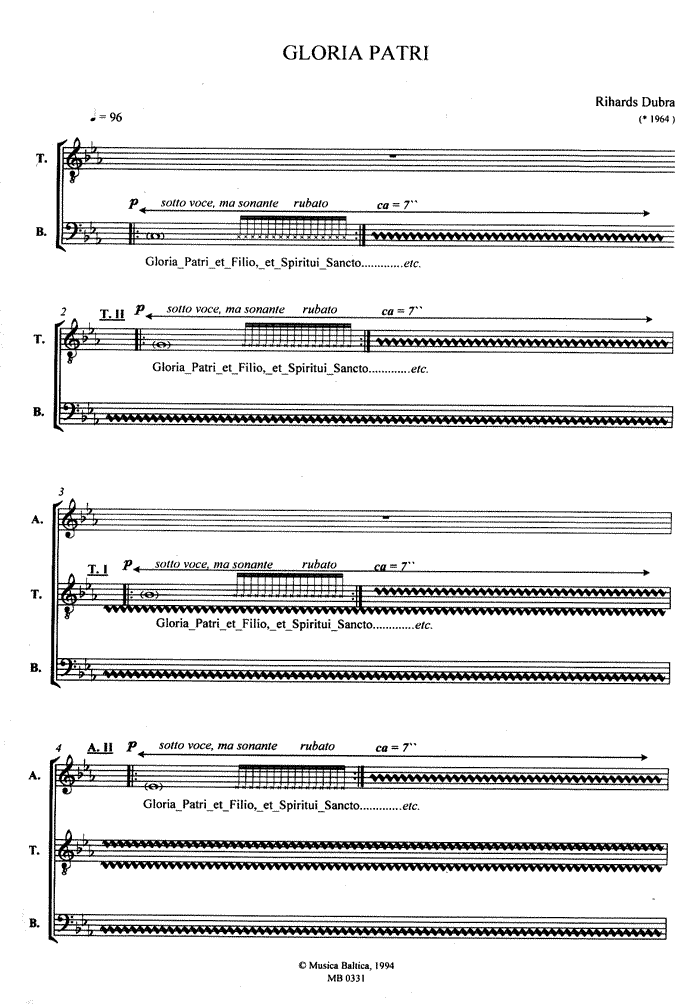
Dubra and Gloria Patri
 Rihards Dubra and the Gloria Patri.
Tell me if you like this work.
See the picture of the score and listen to the recording. I have a full copy of the piece and I wonder what the choir thinks of it.
Friday, March 23, 2007
Today's rehearsal
 Choir,
I was proud of you today. You sang with energy and excitement. It looks like you love what you do and like you love one another. I know I'm a little bit of a nut (well, maybe a lot) and one of the reasons is because I really like being with you.
You are top notch musicians.
You are wonderful people.
I'm a lucky guy.
Rise up, my fair one, and come away
I thought you might like to see the text of "Rise up" in context. There is a "puritan" commentary of the text here. Many people list this choral work as a favorite for weddings . . . not that I'm promoting the idea of marriage to young college students . . .
From the Song of Solomon:
I am the rose of Sharon, and the lily of the valleys. As the lily among thorns, so is my love among the daughters. As the apple tree among the trees of the wood, so is my beloved among the sons. I sat down under his shadow with great delight, and his fruit was sweet to my taste. He brought me to the banqueting house, and his banner over me was love. Stay me with flagons, comfort me with apples: for I am sick of love.
His left hand is under my head, and his right hand doth embrace me. I charge you, O ye daughters of Jerusalem, by the roes, and by the hinds of the field, that ye stir not up, nor awake my love, till he please. The voice of my beloved! behold, he cometh leaping upon the mountains, skipping upon the hills.
My beloved is like a roe or a young hart: behold, he standeth behind our wall, he looketh forth at the windows, shewing himself through the lattice. My beloved spake, and said unto me, Rise up, my love, my fair one, and come away. For, lo, the winter is past, the rain is over and gone; The flowers appear on the earth; the time of the singing of birds is come, and the voice of the turtle is heard in our land; The fig tree putteth forth her green figs, and the vines with the tender grape give a good smell.
Arise, my love, my fair one, and come away. O my dove, that art in the clefts of the rock, in the secret places of the stairs, let me see thy countenance, let me hear thy voice; for sweet is thy voice, and thy countenance is comely. Take us the foxes, the little foxes, that spoil the vines: for our vines have tender grapes. My beloved is mine, and I am his: he feedeth among the lilies. Until the day break, and the shadows flee away, turn, my beloved, and be thou like a roe or a young hart upon the mountains of Bether.
From the Song of Solomon:
I am the rose of Sharon, and the lily of the valleys. As the lily among thorns, so is my love among the daughters. As the apple tree among the trees of the wood, so is my beloved among the sons. I sat down under his shadow with great delight, and his fruit was sweet to my taste. He brought me to the banqueting house, and his banner over me was love. Stay me with flagons, comfort me with apples: for I am sick of love.
His left hand is under my head, and his right hand doth embrace me. I charge you, O ye daughters of Jerusalem, by the roes, and by the hinds of the field, that ye stir not up, nor awake my love, till he please. The voice of my beloved! behold, he cometh leaping upon the mountains, skipping upon the hills.
My beloved is like a roe or a young hart: behold, he standeth behind our wall, he looketh forth at the windows, shewing himself through the lattice. My beloved spake, and said unto me, Rise up, my love, my fair one, and come away. For, lo, the winter is past, the rain is over and gone; The flowers appear on the earth; the time of the singing of birds is come, and the voice of the turtle is heard in our land; The fig tree putteth forth her green figs, and the vines with the tender grape give a good smell.
Arise, my love, my fair one, and come away. O my dove, that art in the clefts of the rock, in the secret places of the stairs, let me see thy countenance, let me hear thy voice; for sweet is thy voice, and thy countenance is comely. Take us the foxes, the little foxes, that spoil the vines: for our vines have tender grapes. My beloved is mine, and I am his: he feedeth among the lilies. Until the day break, and the shadows flee away, turn, my beloved, and be thou like a roe or a young hart upon the mountains of Bether.
Healy Willan
 From a brief bio:
b. 1880, Balham, London; d. 1968, Toronto
Healey Willan began his musical training at age eight, with studies at St. Saviour's Choir School, Eastbourne. After leaving the school in 1895, he began working as an organist and choirmaster in and around London, including at St. John the Baptist, Holland Road, in 1903. Willan became a member of the London Gregorian Association—a society committed to the preservation and revival of Gregorian Plainchant—in 1910.
Although his formative years were spent in England, Willan spent most of his life in Canada and is best known as a Canadian composer and professor. In 1913 he began teaching at the Toronto Conservatory as head of the theory department, and the next year he was appointed a lecturer in music at the University of Toronto. He later became vice-principal of the conservatory, as well as university organist, music director of the Hart House Theatre, and precentor at St. Mary Magdalene. In 1934, Willan founded the Tudor Singers, a Canadian vocal group he conducted until it disbanded in 1939.
Willan’s considerable output includes orchestral, choral, organ and piano, and chamber works, as well as music for plays and one opera. He is best known for his organ and sacred works, which show evidence of his love for plainsong and Renaissance music. For example, many of his liturgical compositions are based on church modes that date back 500 years. Also, his vocal lines are more melismatic and his style more contrapuntal and rhythmically free than those of his contemporaries. Willan’s larger choral works, however, were very Romantic in nature. His rich harmonic palette and luxuriant, soaring melodies stand as testament to his admiration of both Brahms and Wagner. His music represents a unique and beautiful combination of styles: both an homage to the sacred music of five centuries ago and a reflection of the innovations of the Romantic/post-Romantic period in which he lived.
Dziedot dzimu, dziedot augu and Alfreds Kalniņš
 A great piece of Latvian music about singing. See a picture of the score here.
The composer was Alfred Kalniņš (1879 - 1951). His biography:
The founder of Latvian national opera and the finest early 20th century Latvian composer of solo songs. He has also enriched a variety of genres – piano, organ, orchestral, ballet and choral music, as well as arrangements of folk music – with his romantically unrestrained use of poetic imagery and subtly picturesque treatment of the folk idiom. A pupil of Anatoly Lyadov at the St.Petersburg Conservatory (1897–1900), Kalniņš preferred the delicate expression of moods in miniatures, an approach whose roots and analogues can also be traced to the national schools of Northern European composers – in the works of E.Grieg, S.Palmgren, and E.Melartin.
In the 1920s Kalniņš worked for a short time at the Latvian National Opera, mounted the first performances of his operas Baņuta (1920) and Salinieki (1926), and gave organ recitals. During this period his national romantic musical style became even more picturesque, refined and expressionistic. His development continued during his years in New York (1927–33), when his orchestral, piano and organ works were influenced also by constructivism, although this did not affect his choral music.
Numbering over 100, his works for choir are often narrative and ballad-like, lyrical-epic in nature, with a dramatic pathos and a joyful enthusiasm inspired by the social struggle of his time. In the period up to 1918 Kalniņs' choral works sometimes touch on the genre of the Latvian romantic ballad, but in his poetic perception he also makes use of idyllic pastoral scenes, painted in his own dreamy or mournful fashion, where nature often appears as a personification of his native land.
Most of his over 120 folk song arrangements for voice and piano were written in the 1920s, whereas the 1930s and 1940s saw the creation of his most important choral arrangements, about 40 in all. In his arrangements Kalniņš respects the harmonies based on natural folkloric scales, yet he also employs chromatic elements for harmonic colour and favours a rich choral texture.
Thursday, March 22, 2007
Si, ch'io vorrei morire

See the FONT inspired by the Madrigal.
Or do some heavy reading on the Monteverdi Madriglas.
A better translation of the text:
Si, ch'io vorrei morire | Yes, I would like to die |
Subscribe to:
Posts (Atom)